Foxglove
Episode 6 of a facetious yet informative series on murder method.
You’d be forgiven if, by the end of last summer’s bloom season, you were just so done with the common foxglove. The naturalized but non-native Digitalis purpurea had a bumper season, and if you’re a reader of murder or a writer of murder—or simply someone who murders—you’d have found it impossible to go for a walk or a drive—or just meditate in your Adirondack chair with your murder-planning notebook at your elbow—and not think about all the ways that nature’s bounty could be put to good use.
As blooms fade and autumn rains set in, every gardener surveys the fall harvest and looks ahead to the warming soups and stews of the winter season. This episode of the Backyard Poisoner is for those gardeners, writers, and killers who crave a new recipe for foxglove murder: no more foxglove leaf tea, no more foxglove leaf and spinach salad, no more ho-hum digitalis martinis. Take advantage of that under-utilized household staple—the large glass mason jar—and ferment your murderous instincts in the latest ancient-but-contemporary culinary trend: sauerkraut.
Start today, and your digitalis sauerkraut (spicy Korean, or mild) will be ready for Christmas—a perfect pairing with holiday ham or as a complement to mashed potatoes and braised turnip. Smaller condiment jars are perfect as stocking stuffers, or—if you’re one of those backyard poisoners who dehydrates things—as part of a larger gift basket of dried death cap mushrooms and homemade aconite poultry seasoning.
The leaves of the foxglove tend to be bitter, with a distinctive smell; fermentation offers the ideal camouflage. But the real beauty of the fermentation process is that it increases the yield of digoxin, one of the primary toxins of foxglove; it doesn’t make the naturally occurring toxin any stronger, but it enables a greater material: extraction ratio.[1]
This means you can kill more people with less.
In most climates, the common foxglove is a biennial, which means the blooms you see in the summer are from the seeds of two summers ago; after blooming, the plant typically dies. In temperate zones, however, Digitalis purpurea is a perennial; plants bloom several years in a row, getting larger with each season.
There are annual foxgloves and true perennial foxgloves as well,[2] any of which will do the job nicely, whether “the job” is gardening or poisoning. But from a purely aesthetic perspective, I prefer the stately pink, purple, and white spires of the common foxglove. In the dry summers of southern Vancouver Island, these can grow 2 to 3 metres in height, or 6 to 9 feet, creating a veritable foxglove forest, alive with the vibrations of honeybees and hummingbirds.
The leaves that emerge at the base of the stalk in late summer and autumn are the tender leaves of next spring’s mature plants. They become woollier with age, so early collection is best.
I find the smaller, spicier leaves work best in the kimchi-inspired version of sauerkraut, but each backyard poisoner will develop her own unique culinary flair, doubtless finding inspiration in unusual places. At a recent potluck at a friend’s home, for example, where a sassy Indian condiment dressed up humble mac and cheese, I had a vision: once my holiday gift baskets are done, I will experiment with foxglove chutney.
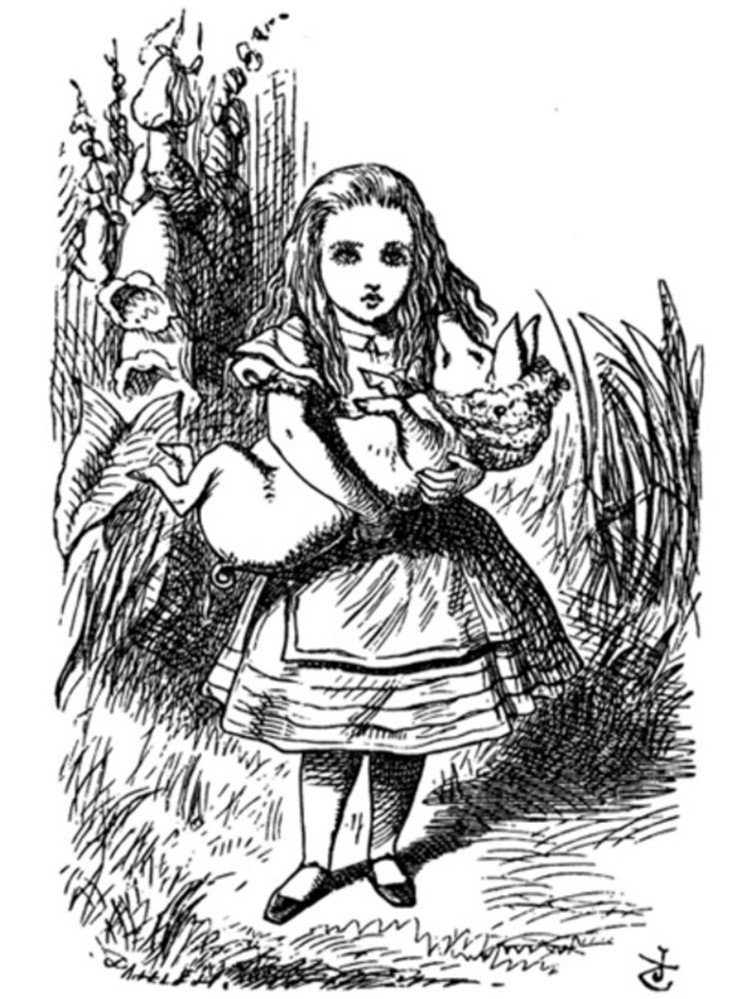
Alice and her holiday ham
Background: Digitalis.
Illustration by Tenniel (for Alice’s Adventures in Wonderland by Lewis Carroll).
Foxglove has a long medicinal history, warranting early mention in the Latin De Historia Stirpium, a mid-sixteenth-century text by German botanist Leonhardt Fuchs, who discusses the plant as an agent to cleanse the body of bad humours. In 1652, Nicholas Culpeper writes of foxglove as a remedy for edema, epilepsy, dropsy, and various other ailments,[3] referring to its ability to heal “any fresh or green wound,” and to “cleanse and purge the body both upwards and downwards.” Culpeper assures us that foxglove is also “one of the best remedies to cure a scabby head that is.”[4]
The most comprehensive English-language historical discussion of digitalis is the 1785 Account of the foxglove, and some of its medical uses: with practical remarks on dropsy, and other diseases, by William Withering, a physician at the hospital in Birmingham. Withering provides case notes for more than 150 patients, all of whom he treated with digitalis, with varying results.[5]
As a remedy for illness and as an agent of murder, foxglove was historically risky; the difference between a medicinal dose and a toxic one is very slight. Negative consequences (or positive ones, depending on your viewpoint) were not unusual.
Thanks to modern science, today we have a much better grasp of the healing and harming properties of digitalis. Digoxin is a cardiac glycoside, a complex molecule that encourages a stronger contraction of the heart muscle and slows the heart rate, allowing the organ to function more efficiently. The compound is used in modern medicine to treat atrial fibrillation and heart failure. It will also bring on abortion in the second or third trimester (by injection into the fetus or the amniotic fluid), as it typically stops the fetal heartbeat.[6]
Because there’s little difference between a healing dose and a harmful one,[7] overdose is easy—to mistakenly take or to purposefully administer. One of the most prolific serial killers in North American history, registered nurse Charles Edmund Cullen, used overdoses of heart medication (often digoxin) to kill as many as 40 patients.[8] More than one pharmaceutical company has had to issue an emergency recall when its medications were found to include inappropriate or inconsistent, potentially toxic, quantities of the active ingredient.[9]
Foxglove sauerkraut
Once your foxglove has seeded, cut back the stalks (taking care not to inadvertently inhale any lingering pollen, seeds, or mould, like the hapless Linda Stradley[10]). Harvest new leaves between September and November, depending on local conditions and personal plans (sauerkraut takes between one and four weeks to mature, depending on depth of flavour desired). Dry the harvested leaves in the sun or with a home dehydrator on your kitchen counter until dry but not crisp.
Take the head of a large green cabbage and peel off the outer leaves. Discard these and remove the core of the cabbage with a sharp knife. Under running water, rinse the cabbage thoroughly. Purists may wish to use filtered water for this step rather than water from a tap; no doubt the victim will appreciate such thoughtfulness.
Allow the clean cabbage to air dry on a cloth or paper towel. Remove one more outer leaf of the cabbage and set aside.
Estimate the weight of the clean, dry cabbage, as this will determine how much salt to use.
Chop the cabbage, sized according to preference. In a large metal bowl, lace the cabbage liberally with salt. Use between 3.5 and 5 teaspoons of salt per pound of cabbage.
Massage the salted cabbage with your hands for 5 minutes. This should result in a significant amount of water. Drain the cabbage, reserving the liquid.
On a new cutting board, and with a different knife (both of which you will wash later in a hot dishwasher, separate from all other kitchen utensils), chop the dried foxglove leaves into pieces the same size as the cabbage.
Add the chopped foxglove to the chopped cabbage; mix well.
Pack the chopped cabbage and foxglove mixture firmly into a large, clean mason jar. Make sure to leave approximately one inch at the mouth of the jar free. Pour the liquid reserved earlier into the mason jar until it just covers the cabbage and foxglove mixture.
Take the single cabbage leaf set aside at the beginning of your preparations and cut it into a circle the same diameter as the inside of the jar. Place this circle of cabbage leaf on the surface of the mixture.
Fill a small Ziploc sandwich bag with clean eyeballs and teeth. If you lack eyeballs and teeth, small, clean rocks will do. Close the bag and set it as a weight inside the mouth of the mason jar, on top of the cabbage leaf. Ensure the cabbage and foxglove mixture remains beneath the surface of the brine. Top off with the remaining liquid, and fasten the lid of the mason jar (old-fashioned metal will do, but plastic lids don’t rust). Set the jar in a pan to collect any liquid overflow. Check your sauerkraut frequently to ensure the cabbage-foxglove mixture is always completely covered by the brine solution. If the liquid level falls too low, top off with salt water; skim off any scum that has accumulated on the surface.
Once your foxglove sauerkraut is done—between one and four weeks, depending on taste, though I don’t recommend going by taste—remove the weighted Ziploc bag and store the sauerkraut in the fridge for up to 2 months until ready to serve or gift.
Hot and spicy Korean-style foxglove sauerkraut (kimchi)
Follow the same steps as above but add to the cabbage-foxglove mixture 2 tablespoons of fresh grated ginger, 6 cloves of garlic,1 tablespoon of sugar, 2 tablespoons of gochugaru (Korean red pepper flakes), 2 green onions, and 1 carrot (julienned). Ideally, serve as a side with bibimbap.
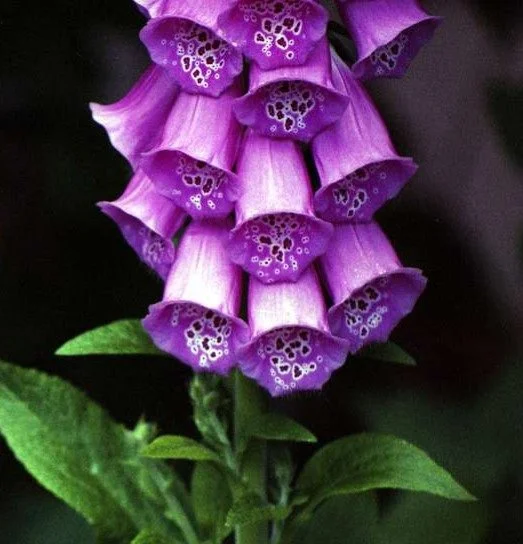
Digitalis purpurea
Gardener’s notes:
These long-lasting spires grace the mid-summer meadow and English-style garden, generally without needing to be staked unless significant winds are expected. Attractive to pollinators and resplendent in large, informal bouquets.
First responder’s notes:
Be prepared to be stumped: symptoms of digoxin poisoning are vague and various. Patient may complain of gastrointestinal discomfort but may not. Vomiting or diarrhea is possible. Patient may seem confused, or not, and may complain of vision changes (blurriness or differences in perception of colour), or not. Heartbeat may be too fast or, alternatively, too slow. Death (due to cardiac arrest) will occur if the dose is high enough, but not all doses are immediately fatal.
Writer’s notes:
Whether a victim ingests foxglove sauerkraut or is poisoned with a pharmaceutically derived alternative, symptoms of digoxin toxicity are the same. A quickly fatal toxic event, however, is more certain if the writer uses an overdose of digitalis medication than if the writer attempts murder by foxglove. (In contemporary cases of ingestion, for example, several days of continuing symptoms have been relieved by medical administration of a digoxin antidote.[11]) The writer should have a good reason for choosing the plant over the medication as a murder weapon.
Pro:
Foxglove is highly toxic and easy to cultivate; the toxin is easy to obtain and prepare. With reasonable precautions, the harvester is not at risk. Cause of death can be disguised as accidental or, in certain circumstances, natural (or at least not unexpected).
Contra:
Sudden symptoms in an otherwise healthy individual will raise suspicions. Murder by digitalis has a storied literary history; unless you present the case in an innovative way, your reader may roll her eyes.
Pathologist’s notes:
If the time between the onset of symptoms and death is short, postmortem tests may reveal toxic levels of digoxin. However, in an individual with normal renal function, the half life of digitalis is 36 hours; if death occurs after several days, there may be little definitive evidence of overdose, particularly if the individual also takes digoxin for medical reasons. Analysis of postmortem digoxin levels may be further complicated by other factors, including the general health of the individual prior to death and natural postmortem processes.
Murderer’s best-case scenario:
The intended victim has a long history of heart problems. He tends to overeat, particularly over the holidays, and has a penchant for flavourful foods. Ideally, he is belligerent and often “takes two” of his daily medication dose, insisting loudly and frequently in the company of others that he knows better than his cardiologist what his body needs.
Final score (taking into account toxicity, certainty, detectability, and ease of use, including preparation and clean-up): 8/10
Footnotes:
[1] V.M. Novković, L.P. Stanojević, M.D. Cakić, R.M. Palić, V.B. Veljković, and M.Z. Stanković. (2014). “Extraction of digoxin from fermented woolly foxglove foliage by percolation”. Separation Science and Technology 49 (6), 829–37.
[2] See the English Garden’s overview on the perennial foxglove.
[3] Including scrofula, or mycobacterial cervical lymphadenitis, known historically as “the king’s evil.”
[4] Nicholas Culpeper, The Complete Herbal. (1652). London: Thomas Kelly, p. 80. Digitized for the University of California Libraries.
[5] Withering’s Account is a good illustration of the historically fuzzy line between “medical intervention” and “murder” and underscores the significance of the phrase “according to my greatest ability and judgment” in that ancient Hippocratic oath of the physician to do no harm. In medicine and murder, everything comes down to how well one knows their practice.
[6] M. Paul, S. Lichtenberg, L. Borgatta, D.A. Grimes, P.G. Stubblefield, and M.D. Creinin. (2011). Management of Unintended and Abnormal Pregnancy: Comprehensive Abortion Care. John Wiley & Sons.
[7] Sola dosis facit venenum, as they say.
[8] Cullen pleaded guilty to criminal charges in the murder of 29 victims but admitted to many more. He was arrested in 2003 and sentenced in 2006 to 11 consecutive life sentences. Associated Press, “Nurse who killed 29 sentenced to 11 life terms”, March 2, 2006.
[9] See the US Food and Drug Administration website and search for “digoxin recall” on the “Recalls, Market Withdrawals, & Safety Alerts” page.
[10] “Foxglove Flower Alert: My Story by Linda Stradley”, What’s Cooking America, n.d.
[11] Renée M. Janssen, Mattias Berg, and Daniel H. Ovakim, “Two cases of cardiac glycoside poisoning from accidental foxglove ingestion”. (2016). Canadian Medical Association Journal 188 (10) 747–50.